Title Tag Length Statistics: 504 Google Title Links Measured
Title tag length statistics from 64 Google SERPs (October 2026): pixel widths of 504 title links, where truncation starts, and how often titles change.
These title tag length statistics come from 504 Google title links on 64 desktop results pages (US, English), collected on 2026-10-12, and from the HTML title tags of the 314 ranking pages we could fetch. Every width is measured in pixels with the same method as our SERP snippet preview tool: canvas text measurement in 20px Arial. The short version: no title shown in full was wider than 577px, truncation began as early as 417px, and Google showed the title tag exactly as written only 31% of the time.
The full dataset is a CSV you can download and reuse: title-tag-pixel-widths-2026-10.csv (504 rows, CC BY 4.0). Methodology and the things this does not measure are at the bottom of the page.
Key title tag statistics
| Statistic | Value | n |
|---|---|---|
| Title links truncated with an ellipsis | 50 (9.9%) | 504 |
| Median width of a title shown in full | 408px, 44 characters | 454 |
| Widest title shown in full | 577px, 65 characters | 454 |
| Width of truncated titles, including the ellipsis | 417px to 601px, median 517px | 50 |
| Median HTML title tag length | 53 characters, 493px | 314 |
| HTML title tags wider than 600px | 63 (20%) | 314 |
| HTML title tags longer than 60 characters | 87 (28%) | 314 |
| Title tag shown exactly as written | 96 (31%) | 314 |
| Title tag shown with a segment removed (usually the site name) | 154 (49%) | 314 |
| Title tag rewritten into different wording | 35 (11%) | 314 |
| Title tags under 500px that were truncated | 1 (0.6%) | 163 |
| Title tags over 600px shown as written | 0 | 63 |
| Average width per character (HTML titles) | 9.3px | 314 |
How wide Google title links are
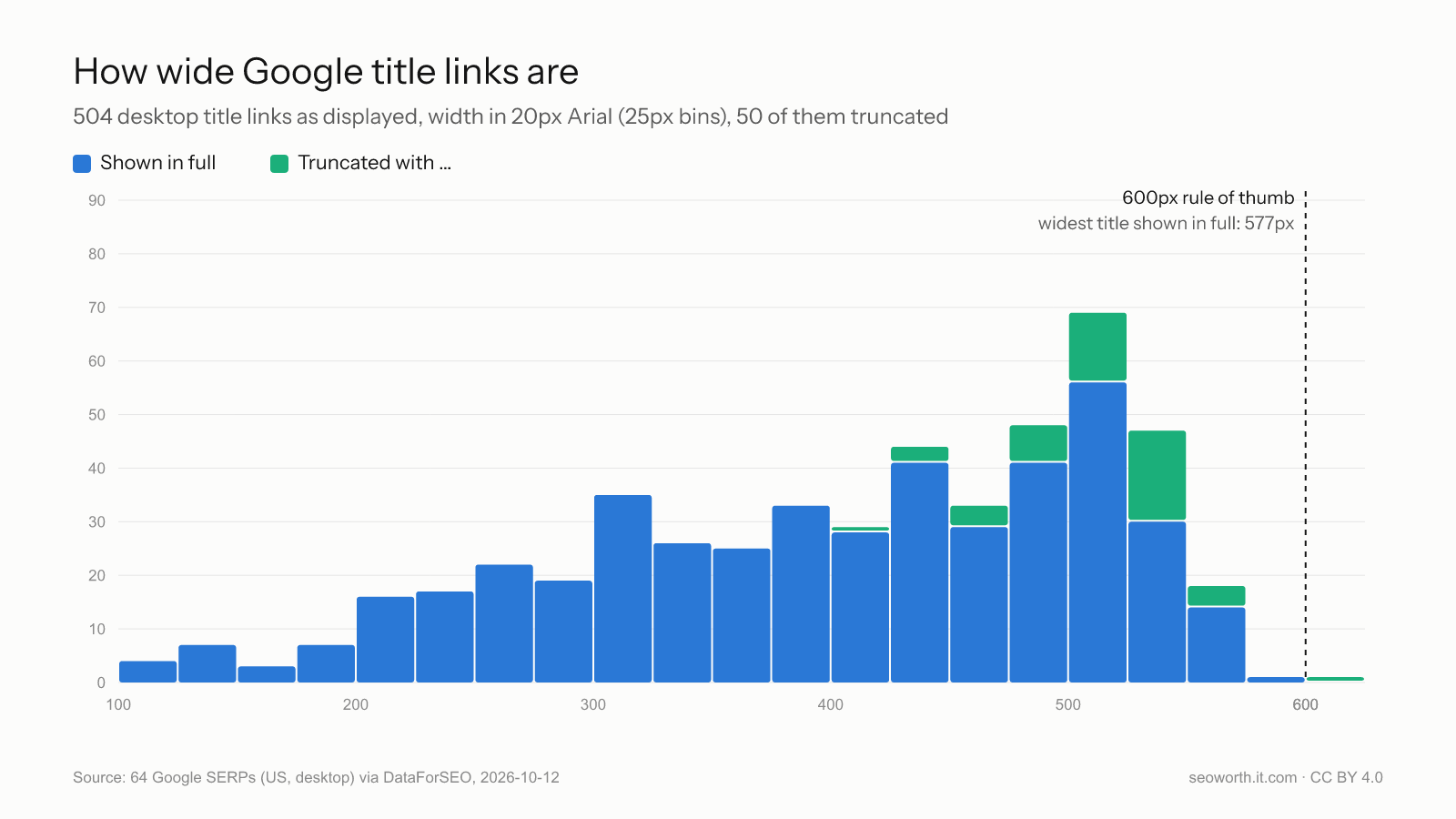
Half of all title links shown in full were narrower than 408px, and 90% were narrower than 525px. The widest one was 577px. That fits the familiar rule that Google’s desktop title link is about 600px wide: nothing past that point was ever displayed whole.
The surprise is how early truncation can start. The 50 truncated title links ended, including the ..., anywhere between 417px and 601px, with a median of 517px. For 22 of them we had the full title tag and could check the next word that was cut. In 19 of those 22, adding that next word and the ellipsis would still have stayed under 600px. One example: Experts Say These Are the Best Indoor Plants for ... was cut at 459px, and the next word, “Gardeners”, would have brought it to 559px.
So 600px is a ceiling, not a promise. Google appears to cut at word boundaries against a budget that varies by result, and our measurement in 20px Arial cannot see whatever Google’s own width calculation adds. The practical reading of this data:
- Under 500px is safe. Only 1 of 163 title tags narrower than 500px was truncated.
- 500px to 600px is a grey zone. 4 of 88 title tags in that band were truncated, and the band had the lowest share shown as written below 600px (27%).
- Over 600px always changes. None of the 63 wider title tags was shown as written. 18 were truncated, 36 lost a segment and 9 were rewritten.
How long ranking title tags are
The HTML title tags behind those results were longer than what Google showed. The median title tag was 53 characters and 493px; the 75th percentile was 61 characters and 573px; the 90th percentile was 79 characters and 731px.
Characters were a reasonable proxy. At an average of 9.3px per character, no title tag of 60 characters or fewer was wider than 600px (0 of 227). The proxy fails in the other direction: 24 of the 87 title tags longer than 60 characters still fit inside 600px, because they used narrow lowercase letters. If you work in characters, 60 is a safe ceiling. If you measure pixels, you get more room on some titles. The meta title length guide explains why letters like W and M cost four times what i and l do.
Ranking position made no visible difference to width. The median title link at positions 1 to 3 was 421px (n=192), at 4 to 6 it was 438px (n=191), and at 7 to 10 it was 431px (n=121).
What Google did with the title tag, by width
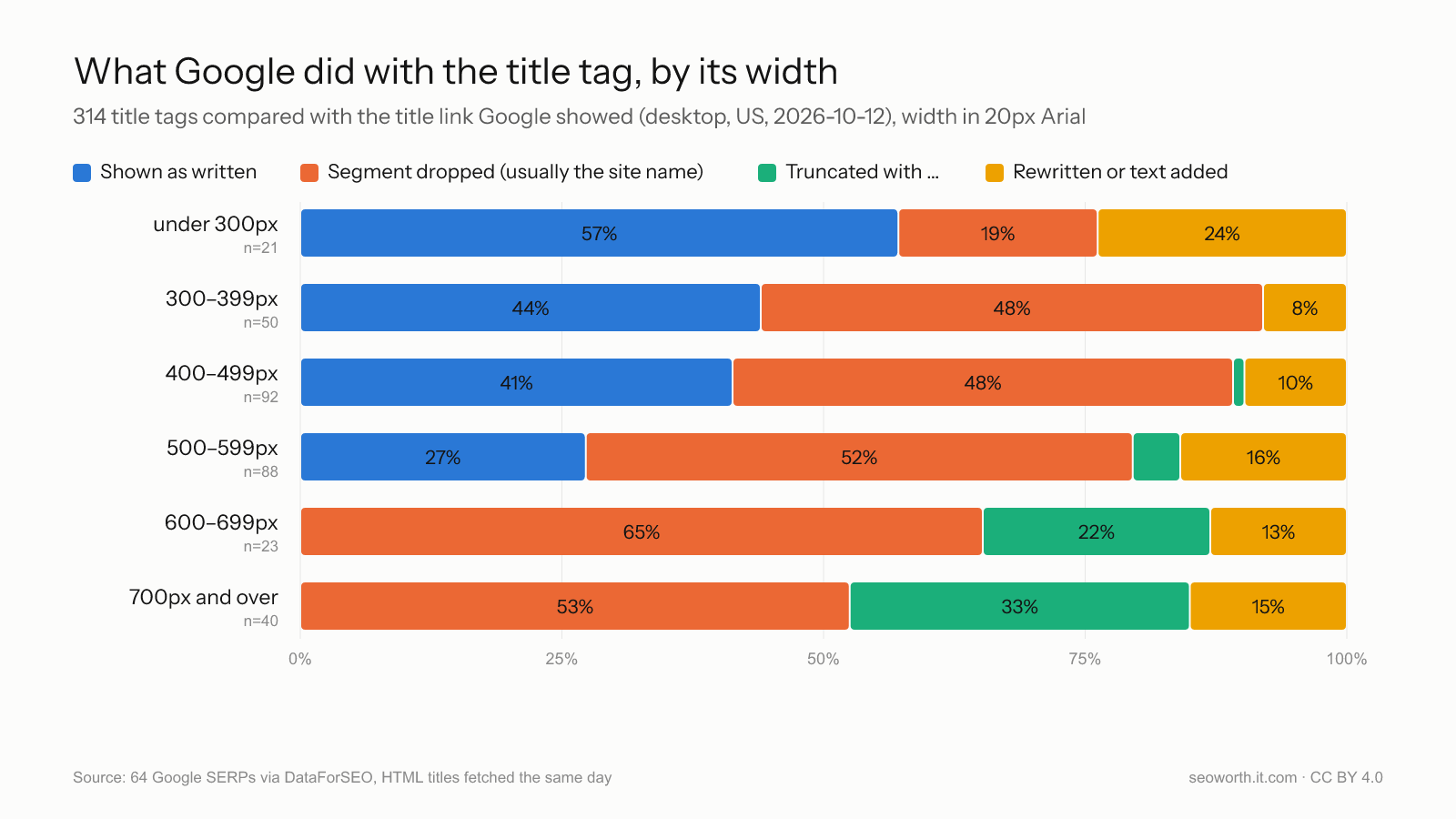
The same data as a table, with counts:
| HTML title width | n | Shown as written | Segment dropped | Truncated | Rewritten | Text added |
|---|---|---|---|---|---|---|
| Under 300px | 21 | 12 (57%) | 4 | 0 | 2 | 3 |
| 300 to 399px | 50 | 22 (44%) | 24 | 0 | 3 | 1 |
| 400 to 499px | 92 | 38 (41%) | 44 | 1 | 8 | 1 |
| 500 to 599px | 88 | 24 (27%) | 46 | 4 | 13 | 1 |
| 600 to 699px | 23 | 0 | 15 | 5 | 3 | 0 |
| 700px and over | 40 | 0 | 21 | 13 | 6 | 0 |
Two patterns stand out. The share shown as written falls steadily with width, from 57% for short titles to zero past 600px. And the most common change at every width above 300px is not a rewrite at all: it is Google removing part of the title.
The site name is the part Google drops
In 140 of the 154 titles with a dropped segment, the removed part was everything after a separator such as |, - or », and that part was almost always the site or brand name. Guide to understanding index funds | Empower was shown as Guide to understanding index funds. Of the 213 title tags that used a pipe or a spaced hyphen, 144 (68%) lost a segment.
This is not a length problem. 118 of the 154 shortened title tags were already under 600px and would have fit. Google now shows the site name on its own line above the URL, so a brand suffix in the title link is often redundant, and Google removes it. The brand still costs nothing in ranking terms and is still worth having for the browser tab, bookmarks and the results where Google keeps it. It is just the part least likely to be seen, which is the argument for putting it last.
The opposite also happened, less often. On 6 short title tags Google added the site name: Beef Stew Recipe was shown as Beef Stew Recipe - NYT Cooking. Of the 15 title tags under 30 characters, 5 were rewritten or extended.
Rewrites into different wording
35 title tags (11%) were replaced with different text. Some were small edits (Do I Really Need 10,000 Steps a Day? became Do I Really Need 10000 Steps a Day?), others were a new title built from the page, like How Much Water Should You Drink? | University of Rochester Medicine shown as Drinking 8 Glasses of Water and Other Myths Debunked. Rewrites happened at every width, from 2 of 21 title tags under 300px to 6 of 40 over 700px. The SEO title examples guide covers the triggers Google documents and how to keep your title link.
Separators and years
Of the 314 title tags, 140 (45%) used a spaced pipe, 87 (28%) a spaced hyphen or dash, and 51 (16%) a colon followed by a space. Some used more than one. A year appeared in 37 title tags (12%) and in 53 of the 504 displayed title links (11%), 44 of the 53 in software and shopping results, where “best of 2026” titles are the norm.
By topic
Eight queries per topic, top 10 organic results each. Software and SEO results had the widest titles; shopping had the narrowest.
| Topic | Title links | Truncated | Median width shown | Title tags matched | Shown as written |
|---|---|---|---|---|---|
| Finance | 64 | 7 | 400px | 50 | 11 |
| Food | 54 | 4 | 400px | 29 | 6 |
| Health | 66 | 7 | 437px | 44 | 16 |
| Home | 55 | 6 | 437px | 33 | 8 |
| SEO | 66 | 5 | 475px | 48 | 17 |
| Shopping | 69 | 5 | 375px | 37 | 12 |
| Software | 65 | 9 | 475px | 38 | 14 |
| Travel | 65 | 7 | 426px | 35 | 12 |
With 29 to 50 matched title tags per topic, differences of a few titles between topics are within noise.
What this means for writing titles
- Write the title to about 500px, not 600px. That keeps the whole title visible in nearly every case we saw, and leaves room for a short brand suffix.
- Put the brand last and expect it to disappear. Google dropped it in two thirds of the titles that had one.
- Do not count on the tail. Anything past roughly 500px may be cut at the previous word.
- Measure before you publish. Paste the title into the SERP preview tool, which uses the same 20px Arial measurement as this study. The rules behind the numbers are in what is a title tag and, for the title-versus-heading question, H1 tag SEO.
Methodology
Results pages. 64 queries, 8 in each of 8 topics (SEO, software, health, finance, shopping, food, travel, home), requested from the DataForSEO Google Organic Live Regular endpoint on 2026-10-12 with location United States, language English, device desktop, OS macOS, depth 10. The endpoint returns organic results only. That gave 504 organic results, each with the title link text as Google displayed it, including the ... when truncated. The full query list is in the CSV.
Title tags. We fetched each result URL on the same day with a desktop Chrome user agent, followed redirects, and took the first <title> element inside <head>, with HTML entities decoded and whitespace collapsed. 314 of the 504 pages returned a usable title. The other 190: 86 returned a status other than 200 (mostly 403), 57 had no title in the served HTML, 25 returned a bot-check page, 21 came from four sites that serve a generic page to scripts (Reddit 12, Amazon 6, Best Buy 2, HGTV 1) and were excluded, and 1 timed out.
The same fetch also recorded each page’s canonical tag; those results are in the canonical tag guide.
Width. Every string was measured with CanvasRenderingContext2D.measureText() using the font 20px Arial in headless Chromium on macOS, rounded to 0.1px. Truncated title links were measured including the ....
Classification. Each matched title was compared with the title link after lowercasing, collapsing whitespace and normalising dashes and quotes. Shown as written: identical. Truncated: the title link ended in ... and the title tag started with the visible text. Segment dropped: the title tag started with or contained the displayed text, with a part removed. Text added: the displayed text started with the full title tag and had more after it. Rewritten: anything else.
What this does not measure
- Mobile. Every number here is desktop. Mobile title links wrap onto more lines and follow different limits.
- Other countries and languages. US, English only.
- Google’s own rendering. We measure in 20px Arial as a browser draws it. Google’s width calculation, fonts on other operating systems and any padding are not visible to us, which may be part of why truncation started below 600px.
- The title Google crawled. We fetched title tags on 2026-10-12. If a page changed its title since Google’s last crawl, a “rewrite” may only be an old title. Pages that blocked scripts are missing, which leaves out some large sites.
- Search features. AI Overviews, sitelinks, video and shopping results were not collected, and nothing here measures clicks or click-through rate.
- Over time. This is one day. A rerun on the same query list will show how stable these numbers are.
- Small changes counted as rewrites. Punctuation and number formatting changes (such as
10,000to10000) are counted as rewrites, which slightly overstates the rewrite share.
- How many characters does Google show in a title?
- In our October 2026 sample of 504 desktop title links, titles shown in full had a median of 44 characters and a maximum of 65. Truncated titles were cut at 47 to 65 characters including the ellipsis, median 57. The limit is a pixel width, not a character count, so the number of characters that fit depends on the letters.
- What pixel width does Google truncate titles at?
- The widest title link shown in full in our sample was 577px, measured in 20px Arial, and the widest truncated one was 601px including the ellipsis. But truncation started much earlier for some titles: 19 of 22 truncated titles we could reconstruct would have fit at least one more word under 600px. Treat 600px as a ceiling and roughly 500px as the zone where truncation becomes possible.
- How often does Google rewrite title tags?
- In our sample Google displayed 218 of 314 title tags (69%) differently from how they were written. Most of those changes were small: 154 had a segment removed, usually the site name, 23 were only truncated, and 6 had text added. 35 (11%) were rewritten into different wording.
- Can I use these numbers and charts?
- Yes. The CSV and both chart images are published under CC BY 4.0. Credit SEO Worth and link to this page.
[ READ NEXT ]
Alt Text for SEO: Image Alt Text Examples & Rules
How to write image alt text for SEO: what Google does with it, good and bad alt text examples, decorative images, and data from 2,241 images.
Meta Title Length: Character Limit & Pixel Width
Meta title length: the 50–60 character rule, the ~600px width Google cuts titles at, measured examples, and how to check a title before publishing.
SEO Title Examples: 40 Title Tags & Best Practices
40 SEO title examples by page type, real Google titles critiqued, and the rules behind good title tags: the title keyword, structure, separator and length.
Get the weekly SEO brief
Practical SEO tips, tool releases, and search news. No spam, unsubscribe anytime.